
Old Ignatian Feature: Peter O'Brien
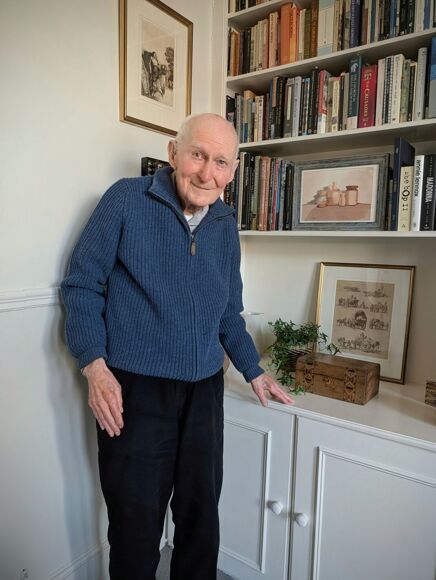 Old Ignatian Peter O'Brien
A School That Never Left Him
Peter O'Brien came to Saint Ignatius almost by accident. He never quite got away.
It was 1942, and the school was not where it was supposed to be. St Ignatius College had been evacuated from Stamford Hill at the outbreak of war and was operating out of a disused village school and the back of a shop in Hemel Hempstead. Peter O'Brien, eleven years old, had arrived not because it was his family's natural choice, but because there was no room for him where the family usually went.
"It was one of those things where God decided otherwise," he says now, more than eighty years on. "You look back and you see it must have been him that brought it all about."
His elder brother had won a scholarship to the Salesian College in 1940. Peter won one too in 1942, put the Salesians down as his first choice, and was turned away: all their places that year were taken by boys from their own prep school. His mother asked the head of his elementary school for advice. The answer came back: the Jesuits are evacuated to Hemel Hempstead. Not far from Hertford, where the family were then living. Try there.
They accepted him. His four brothers all went to the Salesians. Peter went to St Ignatius College.
"I never regretted it for a moment once I got there."
The school Peter joined was tiny, makeshift, and, by his account, extraordinarily alive. The first three year groups were crammed into a small village school at Pickett's End, half a mile outside the town. The upper school used premises on the high street. All the teachers, bar one, were Jesuits. There were perhaps 150 boys in the whole school.
For a year and a half, while the rest of the school returned to Stamford Hill, Peter and around 35 others remained in Hemel Hempstead under the care of a single Jesuit, Father Delahunty, who taught them every subject he could cover. When Peter finally rejoined the main school in January 1945, he was, by his own account, academically ahead of his year group, and he spent the rest of that year, as he puts it, 'cruising', coasting comfortably on work he had already covered.
At the centre of the school, in Hemel Hempstead and then back in Stamford Hill, was the headmaster, Father Brinkworth. He had taken charge in 1940, and by the time Peter encountered him again in 1945 he had begun transforming the school, over the next few years introducing rugby, building new classrooms during the summer holidays, running night studies from five to seven in the evening so that boys from cramped homes had somewhere quiet to work. He was, in Peter's telling, unlike any educator he had encountered before or since: direct, brilliant, restless, and possessed of a peculiar gift for seeing what a boy might become.
"He was very direct. He had quite a musical voice. He talked to us as though we were young men and he was simply an older man."
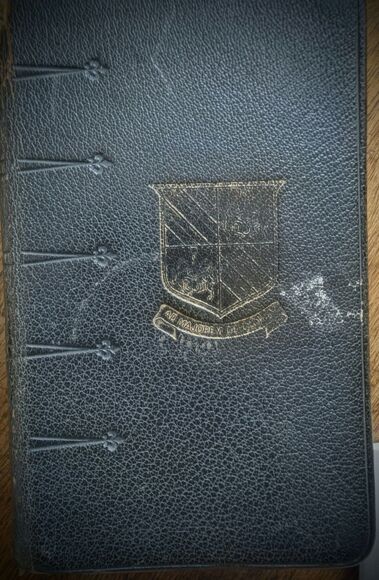 Peter O'Brien's diary from St Ignatius
Father Brinkworth's Sixth Form Religious Doctrine classes ranged from Kant to Hegel to C.S. Lewis to DNA, which he was apparently discussing a decade before it entered public consciousness. "He was saying, in Biology there's some very interesting work going on," Peter recalls. "And he named it as work to do with nucleic acids: RNA and DNA. Everyone had this DNA in them and it was really what was helping you to grow up and become the person you became. This was what he was telling us in 1948."
Not all the lessons were lectures, and not all of them were serious. Fr Brinkworth would circulate books, expect notes to be taken, and in Lent assign each sixth-former two Commandments to teach back to the class. Peter drew the Sixth and the Ninth: thou shalt not commit adultery, and thou shalt not covet thy neighbour's wife (topics on which a Sixth Form boy could claim rather little first-hand authority).
"All the other boys were giggling, wondering what I would make of it. So I thought: right, I'll engage the sixth-formers and get them talking to me." He managed (rather than being laughed off, by his own account). "At the end of it, Father Brinkworth just said, 'Well, he seems to know an awful lot about what he's talking about.'"
That, Peter suggests, was very much the method. In Jesuit schools of the period, the Upper Sixth was known in some places as Rhetoric: the art of performing thought, not merely receiving it. Fr Brinkworth's RI classes were doing something similar. You were not a vessel to be filled. You were a person being formed.
Peter was not, by his own account, an obvious candidate for School Captain. He had avoided rugby by scheduling his piano lesson on Saturday mornings. When he moved into the Sixth Form he began playing the organ for Benediction instead, a rather different way of making himself known. He was not a prefect in the Lower Sixth, nor in the Upper. It was only late in his second year of Sixth Form, when he was already planning to apply for an Open Scholarship to Cambridge, that Fr Brinkworth summoned him.
The meeting did not happen in the headmaster's study. Fr Brinkworth was working on building something near the canteen, and asked Peter to walk with him as he crossed the playground.
"He said to me: I'm going to make you School Captain. Just like that. And he said, I also need some help with this (meaning his bit of bricklaying work). In that very downbeat way that he had. Leaving me absolutely flabbergasted."
The appointment came with further responsibilities: Under Officer in charge of the Cadet Force, which meant such things as organising a church parade in Essex and generally being nudged, in Brinkworth's characteristically oblique way, toward a life of consequence. "That was his way of inching you in the right direction," Peter says. "A lot of tiny nudges."
He sat the Cambridge Open Scholarship exam in December of that year. When the telegram arrived at the family home confirming he had won a place at Christ's College, his mother rang the school. Peter rushed from assembly to the secretary's office to hear the news. Coming out, he passed Father Brinkworth in the corridor and told him.
"Work of the devil," said Brinkworth, and walked straight past him into his office.
Peter thought about that for years afterwards. "I think what he meant was exactly that, that it was the work of the devil, and that he had thought I had been sidetracked from joining the Jesuits."
He laughs at the memory. He had always imagined himself a married man.
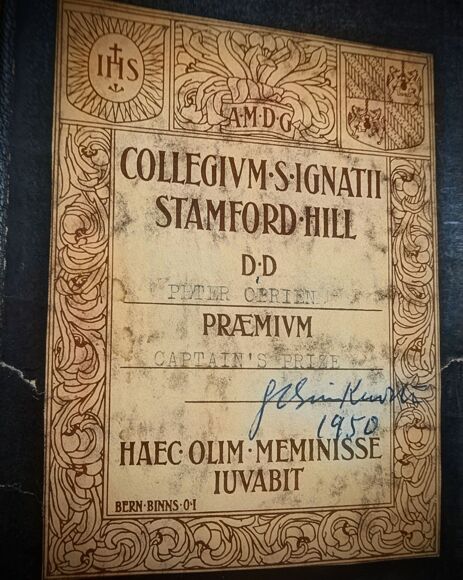 Peter O'Brien's diary from St Ignatius
He went to Cambridge, completed his PGCE, served two years in the army before eventually coming back to Stamford Hill in 1956, where Fr Brinkworth offered him a timetable of History, Latin and Music.
"It was a very different school by then," he says. The makeshift wartime school of 150 boys was now approaching 600 at Stamford Hill, running a four-stream entry, with cohorts of a hundred boys a year moving steadily upward through a school that Brinkworth had continued to build, quite literally, around them.
Peter taught at St Ignatius College for seven years, all of them at Stamford Hill. He had ambitions to run his own History department, and while a couple of earlier opportunities didn't quite come together, a planned new Jesuit school in Essex, a colleague's move to Preston, a headship that went to someone else, he kept his sights on it. He and a colleague had even bought houses at Ware out beyond Turkey Street, anticipating the school's eventual move north. When nearby Broxbourne Grammar School advertised for a head of History, he applied, and got it. It was the role he had been working toward, and the move that finally took him away from St Ignatius College.
His book, Evacuation Stations, keeps the school and its strange, scattered, improvised version of itself alive on the page: the village school at Pickett's End, Father Delahunty covering every subject, Father Brinkworth walking across the playground to help arrange the next chapter of an unsuspecting student's life.
The unlikely school that took in Peter O'Brien shaped him so thoroughly that he spent seven years teaching there as an adult. He still talks about it with the precision and warmth of someone who has been turning the memories over for decades.
"I never regretted it for a moment."
He came to St Ignatius College almost by accident. He stayed, in every sense that mattered, for the rest of his life.
Peter O'Brien was a pupil at Saint Ignatius College from 1942 to 1950. He served as School Captain and won an open scholarship to Christ's College, Cambridge to study history. He returned to teach at the school from 1956 to the early 1960s. His memoir, Evacuation Stations is:
-
Available used on Amazon
-
Reviewed by Fr Michael O Halloran SJ on the Thinking Faith website.
Stories like Peter's are what the Inspiration Fund exists to make possible for the next generation of St Ignatians. The Fund supports today's pupils with the kind of opportunities, trips, clubs and school occasions that shape a life the way St Ignatius Collegeshaped Peter's. If his story resonates with your own time at the school, you can support it here.
